The Convergence of OT and Cloud
Industrial Control Systems (ICS) and Supervisory Control and Data Acquisition (SCADA) environments were historically isolated from corporate IT networks and the internet — an approach known as “air-gapping.” This model provided inherent security through isolation.
Today, however, operational efficiency demands have driven a wave of cloud connectivity adoption. Real-time remote monitoring, predictive maintenance platforms, and centralized data analytics all require that operational data leave the plant floor and travel through cloud infrastructure.
This convergence creates a fundamentally new threat landscape.
Key Vulnerabilities in Cloud-Connected ICS
Legacy Protocol Exposure
Industrial protocols like Modbus, DNP3, and OPC-UA were designed for reliability in isolated environments — not for security in connected ones. When these protocols traverse internet-connected networks, their lack of native authentication and encryption makes them prime targets for interception and manipulation.
Inadequate Segmentation
Many organizations connect operational technology (OT) systems to cloud platforms using the same flat network architecture as their corporate IT systems. Without proper segmentation and demilitarized zones (DMZ), a breach of a corporate endpoint can cascade directly into production systems.
Insecure Remote Access
The pandemic-era rapid deployment of VPN and remote desktop solutions often left permanent security gaps in industrial environments. SSCG audits consistently find misconfigured remote access points as the most common critical vulnerability in industrial facilities.
The SSCG Cloud Security Framework for ICS
Our Technology Division has developed a layered security framework specifically designed for industrial cloud architectures:
Layer 1 — Network Architecture
- Zero-trust network segmentation separating OT, IT, and cloud zones
- Encrypted tunnels (IPSec/TLS 1.3) for all industrial data in transit
- Hardware security modules (HSM) for key management
Layer 2 — Identity and Access Management
- Multi-factor authentication enforced for all remote access
- Privileged Access Workstations (PAW) for engineering operations
- Just-in-time access provisioning with automatic session termination
Layer 3 — Monitoring and Detection
- ICS-specific SIEM (Security Information and Event Management) integration
- Behavioral baselines for all networked industrial devices
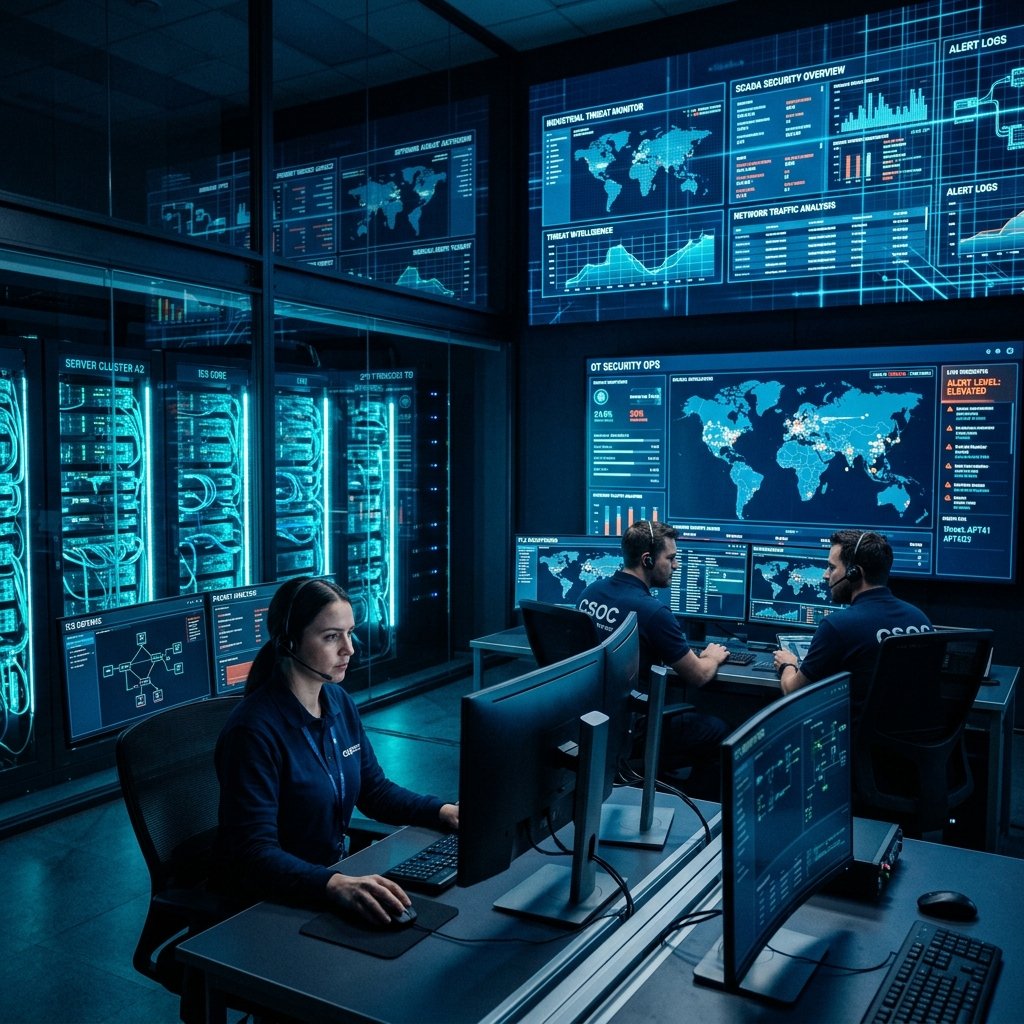
- 24/7 Security Operations Center (SOC) monitoring with sub-15-minute incident response SLA
Layer 4 — Incident Response
- Pre-defined playbooks for common ICS attack vectors (ransomware, supply chain compromise)
- Isolated recovery environments to restore operations without reinfection risk
- Regulatory notification automation for NIS2, NERC CIP, and equivalent frameworks
Why This Matters Now
Cyberattacks targeting industrial infrastructure are increasing at a rate of over 140% year-over-year according to industry threat intelligence reports. The consequences of a successful attack on critical infrastructure extend far beyond data loss — they include physical safety incidents, environmental damage, and massive regulatory liability.
SSCG works with energy operators, refiners, and heavy industrials across the Americas to design and implement cloud security architectures that enable the operational benefits of connectivity without compromising safety or security.
Schedule a complimentary industrial cybersecurity assessment with SSCG’s Technology Division.